English
 Shqip
Shqip Deutsch
 Français
 Español
 Italiano
 Magyar
 Српски језик
 简体中文
简体中文
Saranda is a small town. Quiet in winter, crowded in summer. In the quiet seasons there are more to walk and look around. When the visitor ventures not on the promenade, but on the first and second streets, he reaches places rarely visited besides the post office and banks, such as the municipality, the courthouse, and the hospital on the corner of Rruga Onhezmi and Rruga Studenti.

We are wondering if how many people have asked, searched for the man whose name the hospital in Saranda bears? What we know on the historical exploits in the Albanian borderlands in the 1930-40s?

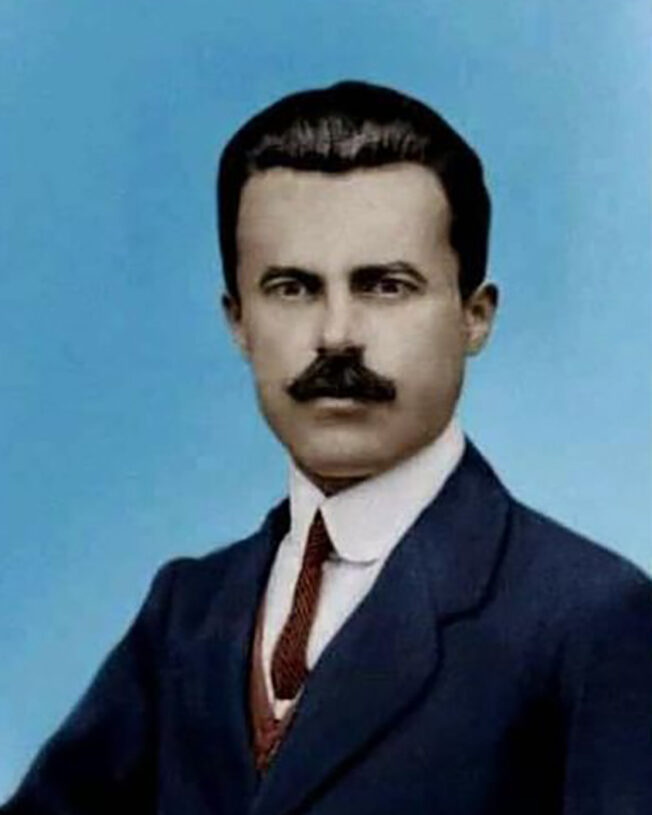
Who was Petro Nako, after whom a hospital was named, with an insignificant plaque and a forgotten statue somewhere outside the city? Our recent research areas include alternative spirituality, collective memory and the exploration of moral sentiments, especially towards the memory of a man after whom a public building was named.
According to sources, Petro Nako was a doctor for the poor. Petro Nako was born in Zminec, Saranda, in 1883. (Albania was not exsits that period of the time, used to belong to Ottoman Empire 1479–1912). He was born and raised in a poor but noble family. That time the southern part around Saranda was filled with epidemics and diseases that were difficult to cure, such as tuberculosis, malaria, contagious diseases, added to the economic poverty of the population and the lack of medicines. Diseases and epidemics wreaked havoc on human life.

Petro was taken by his father to Istanbul. The city where he had emigrated as an economic immigrant. In Istanbul, he completed his secondary education. After graduating from high school, he worked as a teacher in the Marmara region, near Istanbul. In the meantime, he returned to Albania and worked as a teacher in the city of Delvina for four years. But Petro’s dream was to become a doctor. In order to realize his dream, he had to face difficulties and intensive study. This forced him to work at night and study during the day. He managed to achieve his goal.

At the age of 30, he graduated as a doctor. Thanks to his excellent results and special skills, equipped with a broad scientific and professional culture as a doctor, social and multifaceted culture, he was appointed and began working as a doctor in one of the largest hospitals in Athens, “Vangelismos”. During the years of working as a doctor in this hospital, he specialized in general pathology and infectious diseases, in Paris in obstetrics-gynecology and in Berlin in pharmaceuticals. His studies were awarded the title of “Professor” and he managed to master the languages; French, German, Italian and Russian. In his personality, reactions of economic origin would appear, such as dedication and tireless service to the poor population.

Despite the requests he had from several universities in Europe, he decided and came to his native village, in Zminec. In Zminec he married and started a family and this marriage gave him 6 children. Doctor Petro Nako, upon returning to his native village, set to work with great zeal, going from village to village and house to house. It is understandable at that time what a miserable state the Vurgu of Delvinës was in. With swamps and contagious diseases, combined with economic poverty. His service became known throughout the prefecture and villages of Saranda and Delvina. He went wherever there was a need with his simplicity, without boasting, without reward, only to save people’s lives. And this humane work followed him for 18 consecutive years.

Even the stones of the cobblestone streets, across the area, in Christian and Muslim villages, the sick make no difference to the young doctor. He worked for free, he gave his life and blood to the sick, he walked from village to village and house to house, for hours and hours, day and night, eaten and not eaten, without slowing down and quickly, because the disease does not wait, in the rain and in the cold, through the swamps of Vurg in Delvina and Dropulli in Gjirokastra, in Konispol, Dhrovjan, Markat, Sopik, Janjar, Vervë, Dishat, Shala and Nimat, wherever they sought him, wherever they suffered from malarial fever, plevitis, from rheumatism and other ailments, without reward, without praise or favors, so simple, courageous and optimistic about any kind of triumph over the disease and the sick, complete as a doctor, talented, so much so that many, many memories from contemporary witnesses, especially those written, are often even unbelievable for that time, considering the cultural and social level.

Hundreds of people were saved and thousands of diseases were cured by doctor Petro Nako. The sources repeatedly mention that he was an extraordinary humane man, it appears that anyone who knew him, in meetings, conversations or medical visits and treatments, brings a synchronized portrait of him that also brightens the doctor’s soul as a sweet-mouthed, unscrupulous, a man of sacrifice, to the extent that his figure, his activity, have become a myth:
„When people took money out of their pockets to pay him, he would raise his head, look at the rotten, smoking beams under the roof, and laugh bitterly:
– Didn’t you hang a single string of sugarcane this year?!
– Oh, how much is too much for us, doctor!
– And you pay me too much?!
– Yes, it’s your haka.
– It’s okay, it’s okay, keep it for the sick man’s medicine. Doctor Nakua was their close friend and they were his dear friends.
Some, whether doctors, or affendilers, or idiots, would provoke him:
– Why don’t you take money?
– Because they don’t have, what can I take from them, their souls?
That’s all they have left.
– You’re a communist!
– I’m a doctor! My goal is to serve people, not to rob them – and he would explode against the heartless doctors and pharmacists. You exploit the poor, drink their blood! You want the people to always be sick, to strip them, weaken them and kill them.”
On the other hand, his heart accumulated a hatred for the causes of this situation, the deceivers and exploiters of the poor and needy people, unable to buy a single aspirin. In the process, precisely because of these revolting experiences and his dedication to serving the poor, he was given impetus and became active in the LANÇ Movement of the time, but which did not pass without consequences, as this activity caused him to be excluded from medicine and expelled from Greece as an undesirable person.

Ismail Halili, a former partisan, wrote: “I remember when he treated my war wounds, how carefully and lovingly he worked for us partisans. He was tireless as a doctor”. Partisans were treated and healed in his house: Ismail Halili, Luto Demce, Hysen Muharremi, Muho Idrizi, Ahmet Demi, Qerim Azemi, Islam Minga and many others. And where and when? Through the ballistic-Hitler terror. The reaction, looking at this doctor only with the wild eye of sadism, and not at all with that of humanity, of a compatriot, of a comrade, treacherously killed him on April 20, 1944, during an operation in that area. The news of the murder of Dr. Nakos was received with boundless nationwide sorrow and hatred. His entire native village and the partisan units mourned for him, in memory of his life and work.

He lost his life by saving the life of another. The healer of the partisans hiding in the villages above the mountains, he was so devoted that he was executed. But how has this figure been treated in Saranda? Very simply, but not at all with the humanism and not a simple doctor deserve.
Petro Nako in his time, he was a hero and a myth of the area, they talked about him and prayed for him, but today, neither the written nor the built memory leaves a lasting impression on those who left behind him. The stories of doctor Petro Nako deserve to be preserved, both because of his loyalty to his birthplace near Saranda and his respect for human relationships.
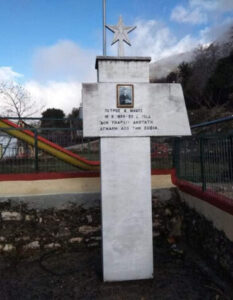
Nothing has been recognize the multifaceted figure of doctor Petro Nako in the urban legend of Saranda . There is only a memorial plaque at the entrance to the hospital and no bust inside the hospital, just as the house where Kristo Kalivopulli was born has that of him.